Should I Trust My Camera or Mirror? The Candid Photography Truth
 Jul, 31 2026
Lens Distortion Simulator
What's Happening?
At 50mm with medium distance, you see a natural perspective similar to human vision. Facial features appear proportional without significant exaggeration or compression.
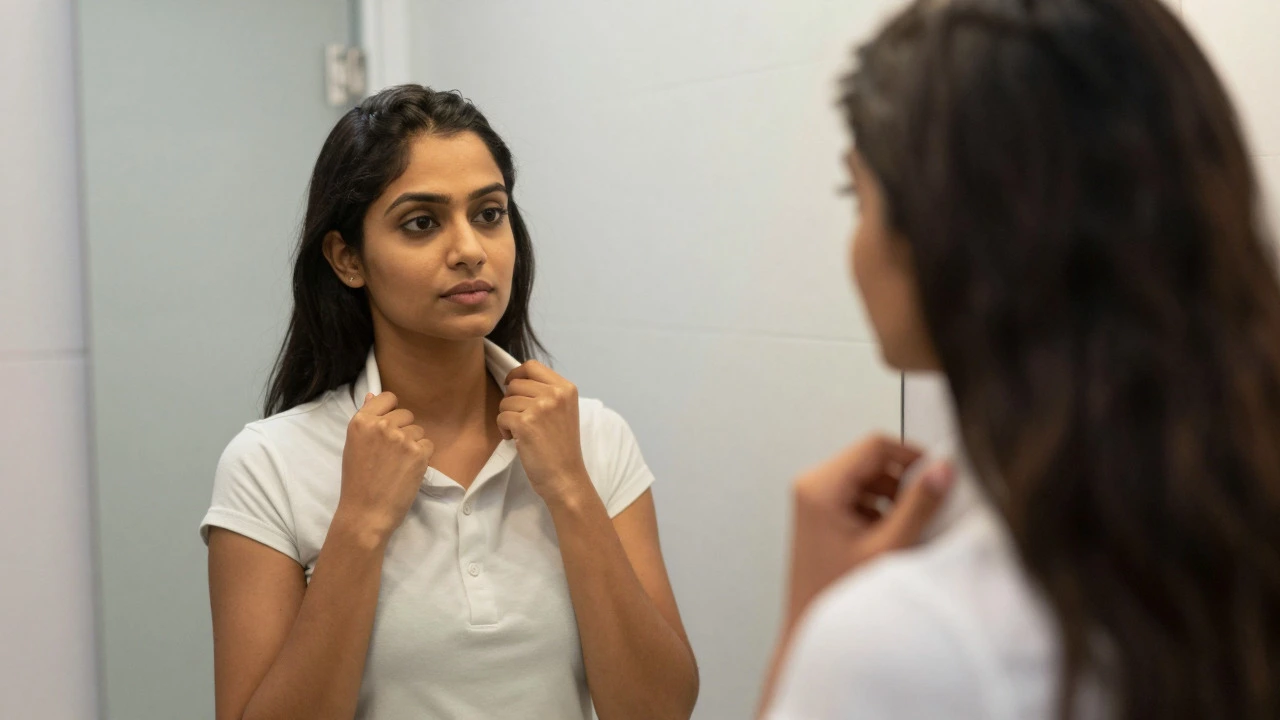
You stand in front of the bathroom mirror. You check your posture, adjust your collar, and maybe pinch your waist to see if you fit into that outfit for tonight's event. Then you take a quick selfie with your phone. Suddenly, you look different. Wider. Taller. Or perhaps just... wrong. This disconnect isn't just vanity; it is a fundamental conflict between optical physics and digital processing. When we talk about candid photography in India, this question becomes even more critical. We are a culture obsessed with looking our best at weddings, festivals, and family gatherings. But when a photographer captures those unposed moments, do they capture reality, or do they capture a distorted version of yourself?
The short answer is: trust neither completely. Both lie. The mirror lies through reflection angles and lighting conditions. The camera lies through lens focal lengths and sensor compression. To understand why you might hate your photos while loving your reflection (or vice versa), we need to break down the science of how we see ourselves versus how machines see us.
The Mirror Illusion: Why You Look Better There
Let's start with the mirror because it feels like the truth. It doesn't process data. It reflects light. However, the human brain has spent decades calibrating itself to what it sees in the glass. This is called mirror adaptation. You are used to seeing your face reversed. You know exactly which side of your nose is slightly crooked or which eye is slightly larger. Because you have seen this reversed image every day since childhood, your brain accepts it as 'normal.'
When you see a photo, you see the non-reversed version. To your brain, this looks alien. It highlights asymmetries you usually ignore. This phenomenon is known as the Mere Exposure Effect. Psychologists have proven that people prefer their mirrored image over their photographic image simply because it is familiar. So, when you ask, "Should I trust my mirror?" the answer is yes, but only because your brain has been tricked into accepting a specific angle and reversal as your identity.
Furthermore, mirrors provide depth cues that cameras often flatten. In a well-lit room, your eyes perceive three-dimensional structure. You can move your head slightly and see shadows shift. A standard camera sensor flattens this into two dimensions. If you have a strong jawline or prominent cheekbones, a mirror shows these features with natural shadow play. A flat photo might make you look softer or rounder than you actually feel.
The Camera Trap: Focal Lengths and Distortion
Now, let's talk about the camera. Most people blame the camera for making them look bad, but they rarely blame the right part of the camera. The culprit is almost always the lens focal length.
If you take a selfie with your smartphone's main camera (usually around 24mm to 28mm equivalent), you are using a wide-angle lens. Wide-angle lenses exaggerate perspective. Objects closer to the lens appear larger, while objects further away appear smaller. If you hold the phone close to your face, your nose will look significantly bigger, and your ears will look tiny. This is not a flaw in your appearance; it is geometry.
In professional candid photography, especially for Indian weddings where photographers use full-frame DSLRs or mirrorless cameras, the rules change. Photographers typically use telephoto lenses, ranging from 50mm to 135mm. These lenses compress the background and flatten facial features. This compression is generally considered flattering because it reduces the exaggerated proportions caused by wide-angle lenses. However, if a photographer uses a 35mm lens indoors to capture a wide shot of a crowded mandap, anyone standing too close to the lens will suffer from barrel distortion.
| Lens Type | Focal Length | Effect on Face | Best Used For |
|---|---|---|---|
| Wide Angle | 14mm - 24mm | Exaggerates nose, shrinks ears, distorts edges | Architecture, tight indoor spaces |
| Standard | 35mm - 50mm | Natural perspective, slight width | Street photography, environmental portraits |
| Portrait/Telephoto | 85mm - 135mm | Flattering compression, smooth skin texture | Candid portraits, weddings, headshots |
Another factor is the resolution. Modern cameras shoot in 24 megapixels or higher. This means they capture every pore, every stray hair, and every blemish. Mirrors, especially bathroom mirrors, are often slightly frosted or dirty, providing a natural softening effect. The camera does not forgive. This hyper-realism can be jarring when compared to the soft-focus view you are used to in the mirror.
The Psychology of Candid Moments
Why does this matter for candid photography? Because candid shots are unposed. You are not holding still. You are laughing, crying, dancing, or talking. In these moments, your facial muscles move dynamically. A mirror allows you to control this expression. You can freeze into a smile. A camera captures the split-second transition between expressions.
Have you ever seen a photo where your mouth is open mid-sentence and your eyes are squinting? That is a real moment. But to the subject, it looks awkward. This is the difference between performance and presence. The mirror supports performance. The camera records presence. In the context of Indian events, where emotions run high during rituals like the Jaimala or Sangeet, the camera captures raw emotion that the mirror never could. You might look 'ugly' in a split second of intense joy, but that photo tells the true story of the day.
Also, consider the angle. When you look in a mirror, you naturally tilt your chin up or down to find your most flattering angle. You subconsciously optimize your view. A candid photographer works from various angles-sometimes low, sometimes high. A low angle can emphasize the chin and double chins. A high angle can elongate the neck. Neither is inherently 'bad,' but they differ from your curated mirror view.
Lighting: The Great Equalizer
Lighting is the third pillar of this debate. In your bathroom, you likely have overhead lighting that casts downward shadows. This creates hollows under your eyes and emphasizes wrinkles. Professional photographers use continuous lighting or flash modifiers to create soft, diffused light. This fills in shadows and makes skin look smoother.
However, in candid situations, photographers often rely on available light. If you are outdoors in harsh noon sun, the camera will capture deep shadows under your brow ridge. If you are indoors with mixed lighting (tungsten bulbs and daylight windows), the white balance might cast a yellow or blue tint on your skin. The mirror, being static, doesn't change color temperature based on external sources in the same way a sensor does. You adapt to the mirror's light; the camera records its flaws.
To mitigate this, good candid photographers avoid shooting directly into bright windows or harsh sunlight without diffusion. They position subjects so the light falls evenly on the face. If you are reviewing your photos and notice uneven skin tones, it is likely a lighting issue, not a physical one.
How to Reconcile the Two Views
So, should you trust your camera or your mirror? Here is the practical approach for anyone concerned about their image in photos, particularly for upcoming events or shoots.
- Stop taking selfies with wide-angle lenses. If you want to test how you look, step back. Use the rear camera of your phone and zoom in digitally, or better yet, use a dedicated camera with an 85mm lens. This mimics how a professional sees you.
- Accept asymmetry. Everyone's face is asymmetrical. Your mirror image hides this because you are used to it. Photos reveal it. Remember that viewers do not scrutinize your symmetry as closely as you do. They see the whole person, the emotion, and the context.
- Focus on the moment, not the pixel. Candid photography is about storytelling. A photo where you look slightly wider but are genuinely laughing with your grandmother is worth more than a perfectly lit, symmetrical portrait where you look stiff. The value of the image lies in the memory, not the metric.
- Check the lens specs. If you are hiring a photographer, ask what lenses they use. For portraits, insist on 50mm or longer. Avoid photographers who rely solely on kit lenses (18-55mm) for close-up shots, as the distortion at the wide end can be unflattering.
Ultimately, the mirror is a tool for grooming. The camera is a tool for documentation. They serve different purposes. Trusting one over the other is like trusting a ruler to measure weight. Neither gives you the complete picture alone. But together, they help you understand that your self-image is fluid, influenced by optics, psychology, and technology.
Practical Tips for Better Candid Results
If you are anxious about how you look in candid shots, here are some actionable steps to take before and during the shoot.
- Hydrate and rest. Dehydration shows in photos instantly. Dark circles and dull skin are amplified by high-resolution sensors. Sleep helps reduce puffiness, which can distort facial contours in wide-angle shots.
- Wear solid colors. Busy patterns can cause moiré effects on camera sensors, creating weird visual vibrations that don't exist in the mirror. Solid colors also reflect light more evenly across the face.
- Move naturally. Don't try to pose for the candid photographer. Engage with others. Laugh. Talk. Motion blur can sometimes soften features, making the image look more artistic and less like a forensic record.
- Review photos later. Do not judge your appearance immediately after the event. Emotional fatigue affects perception. Wait a few days. Often, the initial shock of seeing yourself 'unfiltered' fades, and you begin to appreciate the authenticity of the moment.
In the world of photography, perfection is boring. Authenticity is engaging. Your mirror shows you who you are in a controlled environment. Your camera shows you who you are in the real world. Embrace both, but remember that the camera's job is not to flatter-it is to witness.
Why do I look fatter in photos than in the mirror?
This is usually due to lens distortion. Wide-angle lenses (common in smartphones) exaggerate the size of objects close to the lens, such as your nose and cheeks, while shrinking the background. Additionally, cameras flatten 3D faces into 2D images, losing depth cues that make you look slimmer in the mirror. Using a telephoto lens (85mm+) reduces this effect.
Is my mirror image more accurate than my photo?
Neither is perfectly accurate. The mirror shows a reversed image that your brain is accustomed to, hiding asymmetries. The photo shows the non-reversed image that others see, highlighting asymmetries. The mirror also provides depth perception, while the camera flattens it. Both are partial truths.
What lens is best for flattering candid portraits?
For flattering portraits, use lenses with a focal length of 50mm to 135mm on a full-frame camera. These lenses provide natural perspective compression, minimizing facial distortion and creating a pleasing separation between the subject and the background.
Why do I look worse in selfies?
Selfies are typically taken with wide-angle lenses held close to the face. This causes significant perspective distortion, enlarging central features like the nose and shrinking peripheral features like ears. It also captures you from an unnatural angle that you rarely see in daily life.
Does lighting affect how I look in photos?
Yes, drastically. Harsh overhead lighting creates shadows under eyes and chin, emphasizing wrinkles and double chins. Soft, diffused lighting fills in these shadows, smoothing skin texture. Professional photographers manipulate light to create the most flattering representation possible.
Can camera settings change my appearance?
Yes. High ISO settings introduce noise, which can make skin look grainy. Aperture settings affect depth of field; a wide aperture (low f-number) blurs the background, focusing attention on the face. White balance settings can alter skin tone, making you look yellower or bluer than you are in reality.
Why do candid photos sometimes look awkward?
Candid photos capture unposed, transitional moments. You might be blinking, speaking, or moving. Unlike posed photos where you control your expression, candid shots record raw behavior. This can include awkward angles or mid-action expressions that look strange out of context but tell a genuine story.