Can I Take My Drone From USA To India? A 2026 Legal Guide
 Mar, 27 2026
India Drone Compliance Checker
Compliance Checklist
Ensure you check these items before departure.Created an account on the official government portal?
Does your drone have a valid UIN assigned?
Do you possess a Pilot Competency Certificate or Tourist Clearance?
Plan to keep Li-ion batteries in your Cabin Baggage?
Have you verified if your flight zone requires an NOC (No Objection Certificate)?
Why this matters:
- FAA certificates are invalid in India.
- Customs needs printed clearance proofs.
- Unregistered flights can lead to fines up to ₹10 Lakh.
- Digital Sky app shows restricted zones.
Your Flight Readiness Status
Action Items Required:
You bring your trusted camera gear, maybe even a drone setup you've flown across the States, and you're heading to India for that dream shot of the Taj Mahal or the backwaters of Kerala. But before you pack that carbon fiber frame, ask yourself: Is it actually legal to land and fly a foreign drone in India? The short answer is yes, but the path involves strict paperwork and digital clearances that differ vastly from what you know with the FAA back home. As of March 2026, India has tightened its airspace security, making the Directorate General of Civil Aviation (DGCA) the ultimate gatekeeper for unmanned aerial systems.
The Foundation of Indian Drone Laws
To understand why your drone isn't treated like a simple carry-on item, we need to look at the regulatory backbone. In 2021, India introduced the Drones Act 2021 is the comprehensive legislation governing all civil aircraft operations in India, including remotely piloted aircraft systems (RPAS). The act was designed to streamline the industry while maintaining national security. Unlike the decentralized approach in some regions, India operates under a centralized "one-window" clearance system. This means there is no ambiguity about local police permission; everything flows through the DGCA.
This centralization impacts how you prepare. You cannot simply fly a drone registered in the United States because it holds an FAA Certificate of Authorization. That document is useless in Indian airspace. Instead, every drone landing on Indian soil must be compliant with domestic standards. If you are traveling for photography, you are classified as a pilot-in-command, and your equipment falls under specific weight categories defined by the regulations.
Step 1: Registering Before You Leave Home
Many travelers make the mistake of waiting until they land in Delhi or Mumbai to sort out permissions. By then, you might be stuck in customs with heavy fines if you haven't declared correctly. The process begins weeks before your flight departs. You must register yourself and your drone on the Digital Sky Platform is a cloud-based government portal that handles registration, permits, and tracking for all drone operators in India. This platform is the core interface for the DGCA and serves as the single source of truth for airworthiness certification.
- Create an Account: You will need to provide your passport details, proof of address (which can be your hotel booking confirmation for tourists), and contact information.
- Register Your Drone: Upload photos of your drone, including a clear view of the serial number (S/N) or UIN (Unique Identification Number). If your drone doesn't have an Indian UIN yet, you apply for one here. Foreign-owned drones require temporary registration.
- Pilot Competency Certificate: Even for casual flyers, you often need a basic competency certificate or a Remote Pilot License (RPL). For tourists, the platform offers a streamlined "Tourist Drone Clearance" option, but you still need to pass a brief online assessment regarding safety and airspaces.
Once you submit these details, the system generates a unique QR code linked to your pilot identity and the specific drone unit. Keep screenshots of this approval handy. If you skip this step, border control officers at airports like Kempegowda (Bangalore) or Indira Gandhi (Delhi) may seize the device immediately.
Step 2: Navigating Customs and Logistics
Bringing the physical hardware across the border is just as critical as the digital clearance. When you arrive in India, you must declare your drone at the customs checkpoint. While there are exemptions for personal items, bringing high-end professional gear can trigger Import Duty assessments. You want to avoid paying import taxes twice-once when bringing it in and potentially again if you leave it in the country.
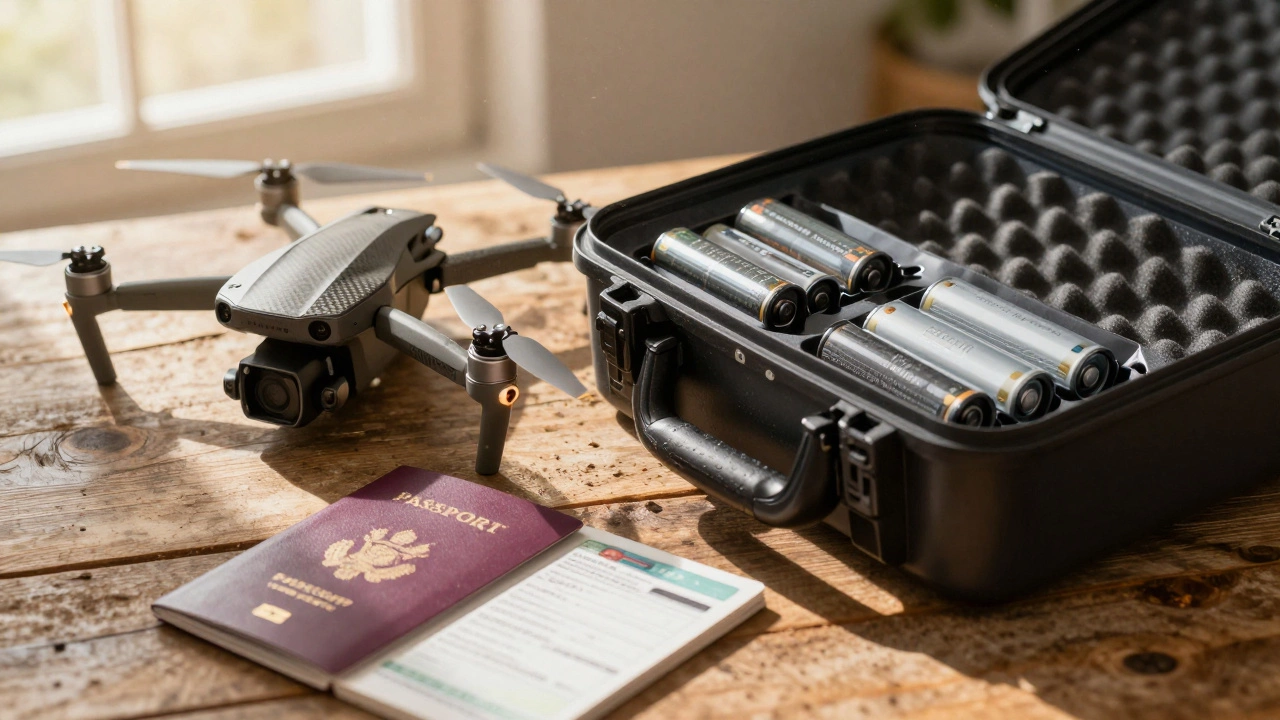
If you are carrying lithium-ion batteries, remember that international airline rules still apply. Most airlines prohibit placing large drone batteries in checked luggage due to fire risks. You must carry spare batteries in your cabin baggage. Ensure each cell is individually protected to prevent accidental activation. Upon arrival, declare these batteries specifically. Customs officials are trained to spot these high-value electronics. Showing them your DGCA registration from the Digital Sky Platform acts as proof that you aren't smuggling unauthorized surveillance technology.
| Item | Requirement Status | Notes |
|---|---|---|
| Drone Body | Mandatory Declaration | Must match registered UIN |
| Lithium Batteries | Cabin Baggage Only | Max capacity varies by airline |
| Digital Sky Approval | Printed Copy | Show to immigration/customs |
| Passport | Carry Original | Used for verification against permit |
Understanding Airspace Restrictions
Just because you have a permit doesn't mean you can fly anywhere. The sky over India is heavily regulated. Certain areas are designated as Permanent No-Fly Zones (NFZs). These typically include military bases, nuclear power plants, dams, and sensitive political sites. Flying within 5 kilometers of an airport, regardless of whether it's currently active, is strictly prohibited without special coordination.
Before taking off, you must consult the Remote ID is a digital broadcast system that identifies the drone and pilot location in real-time to authorities. Indian regulations mandate that eligible drones emit a signal containing their UIN and GPS coordinates. Your American DJI or Autel drone supports this functionality via firmware updates, but ensure you have updated your drone software before traveling.
Furthermore, cultural and religious sensitivities play a huge role. You generally need specific No Objection Certificates (NOC) from local district authorities to film over heritage sites. For example, photographing the Golden Temple in Amritsar or the Gateway of India in Mumbai requires written permission from the local administration, separate from the DGCA flight permit. Attempting to bypass this with a "low altitude stealthy flight" is a quick way to get your gear confiscated.
Fines and Legal Repercussions
The penalties for non-compliance have increased significantly since 2023. Violating drone laws in India is treated as a serious offense, often falling under anti-terror legislation due to past security concerns. Fines range from ₹50,000 (approx. $600 USD) to ₹10 lakh ($12,000 USD) depending on the severity of the breach. More importantly, jail terms of up to three years are applicable for repeated offenses or flights near sensitive military zones.
Consider the scenario of a tourist in the Himalayas. You see a beautiful valley, think it's empty, and take off. However, many valleys fall within restricted military perimeters along the Line of Actual Control. The Digital Sky app sends real-time alerts, but if you ignore the app warnings, the consequences are severe. Border patrols monitor RF signals. An unregistered drone emitting a signal triggers an immediate trace.
Tips for a Smooth Experience
To ensure your photography trip goes smoothly, treat drone usage like a major project rather than a casual hobby activity. Book your accommodation well in advance, and ask your host to help secure the necessary local NOCs. Many hotels in popular tourist circuits are familiar with the process and can guide you to the correct local magistrate office.
Always keep your Digital Sky login credentials accessible offline. Internet connectivity in remote rural areas can be spotty. Having saved PDF copies of your permits ensures that if local police stop you, you can prove immediate compliance. Also, respect the privacy of locals. Capturing footage of private properties or individuals without consent can lead to civil disputes, even if your flight permit is technically valid.
Finally, consider insurance. Standard travel insurance does not cover drone damages or liability. Specialized aviation insurance for RPAS is available online. In case of an accident or damage to third-party property, this coverage protects you from hefty lawsuits. It's an investment that pays for itself during stressful moments.
Preparing for the Return Journey
When leaving India, you face the reverse process. If you paid import duty, you generally cannot re-export the device easily as it is considered "sold" into the country. To circumvent this, keep your temporary import declaration papers safe. Some airports issue a "re-export bond" form which proves you bought the drone elsewhere. If you forgot this, you might be forced to pay duties before exiting. Plan ahead and keep all receipts from the airport arrival zone organized in a dedicated folder.
Do I need a different license to fly in India compared to the US?
Yes. Your FAA Part 107 certificate is not recognized for flying within India. You must obtain a remote pilot license or tourist clearance through the DGCA's Digital Sky Platform before landing.
Can I buy a drone locally in India instead of bringing mine?
Buying locally simplifies customs entry, but you still need to register the drone. Be aware that imported drones are sometimes locked from certain features abroad. Buying a locally assembled model might offer better warranty support.
Are there specific days I am banned from flying?
During major festivals like Diwali or Election periods, temporary bans are enforced nationwide. Check the DGCA alert notifications on the Digital Sky dashboard daily before planning a shoot.
What happens if my drone gets stuck or lost?
If the drone crashes, you must inform the local police immediately to avoid theft accusations. Retrieve the device and file an incident report within 24 hours on the Digital Sky platform.
Is night flying allowed for tourists?
Night flying requires specific advanced permissions and approved lighting systems on the drone. Generally, it is denied for tourist clearances unless authorized for specific commercial events or research projects.